
Most British hospitals encounter patient communication barriers that risk safety when medical documents are not translated accurately. Even a single mistranslation can lead to incorrect treatments or compliance issues that place patient lives in jeopardy. For British healthcare professionals managing sensitive records, precise Spanish translation is vital to uphold clinical standards and meet legal requirements. This guide highlights the key aspects of accuracy, document complexity, regulations, and best practices to support seamless patient care and compliance.
Table of Contents
- Defining Translation Accuracy In Healthcare
- Varieties And Complexity Of Medical Documents
- Legal And Regulatory Requirements For Translation
- Risks Of Inaccurate Medical Translation
- Best Practice For Ensuring Translation Precision
Key Takeaways
| Point | Details |
|---|---|
| Importance of Accuracy | Medical translation accuracy is crucial for effective communication between healthcare providers and patients, impacting treatment outcomes and safety. |
| Complexity of Documents | Various medical documents require different translation approaches, necessitating specialised knowledge of medical terminology and regulatory requirements. |
| Legal Compliance | Translators must be aware of legal frameworks governing medical documentation to ensure translated materials meet regulatory standards. |
| Quality Assurance | Implementing rigorous quality assurance processes and employing qualified medical translators are vital to mitigate risks of inaccuracies in medical translations. |
Defining Translation Accuracy in Healthcare
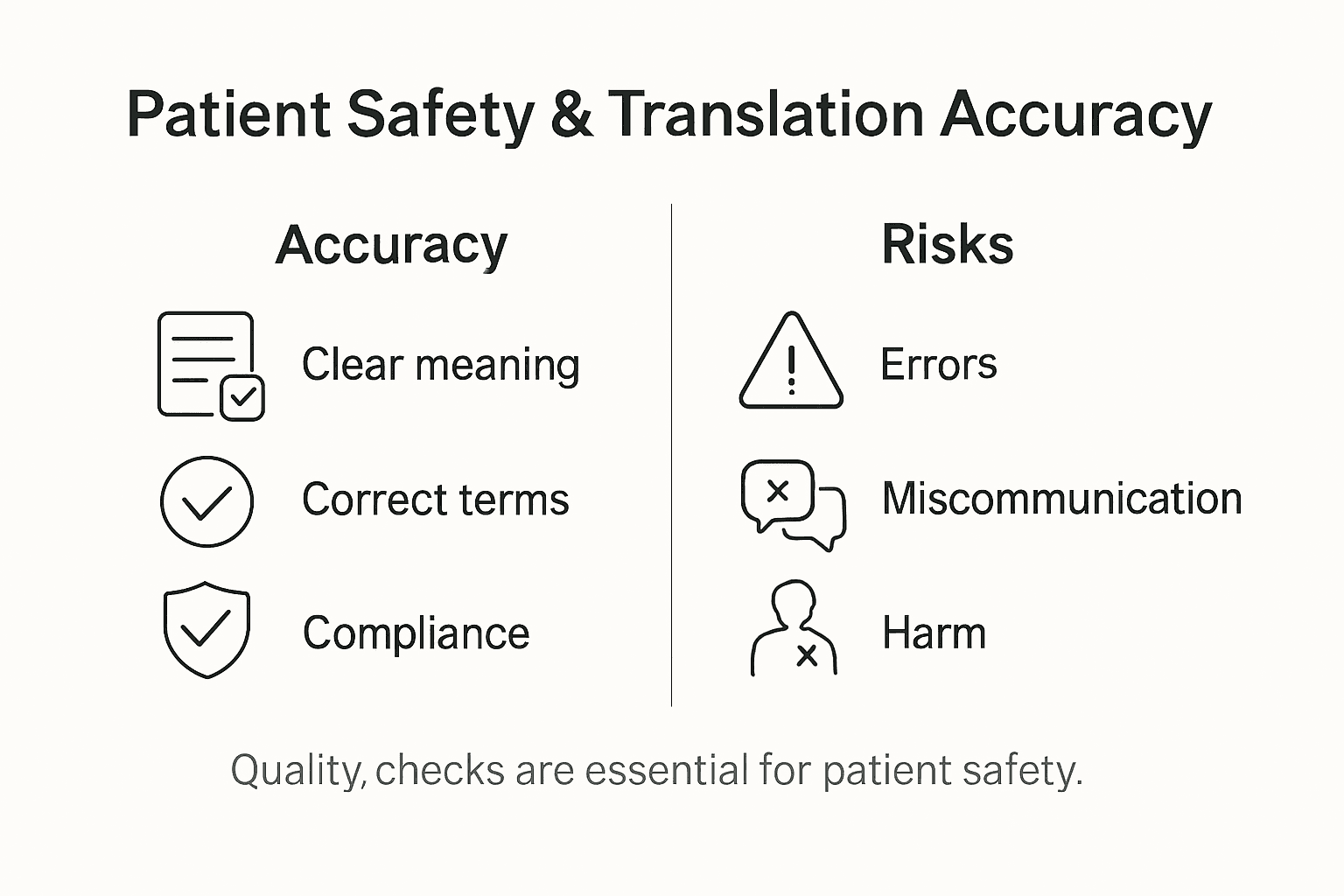
In medical translation, accuracy is far more than linguistic precision—it represents a critical lifeline between healthcare professionals and patients from diverse linguistic backgrounds. Accurate medical translation serves as an essential bridge that connects patients with vital health information, potentially determining treatment outcomes and patient safety.
Translation accuracy in healthcare encompasses multiple sophisticated dimensions. It requires not just word-for-word translation, but a comprehensive understanding of medical terminology, cultural nuances, and contextual meaning. Translators must precisely transfer complex medical knowledge, ensuring that technical terms, diagnostic descriptions, treatment protocols, and patient instructions retain their original medical integrity across language barriers. Misinterpretations or imprecise translations can lead to serious consequences, such as incorrect diagnoses, inappropriate treatments, or patients misunderstanding critical health guidance.
Professional medical translators employ rigorous methodologies to guarantee accuracy. These include deep subject matter expertise, continuous medical terminology training, and collaborative verification processes involving medical professionals. They must understand medical subspecialties, comprehend intricate diagnostic language, and maintain absolute precision in translating everything from patient medical histories to complex research documentation.
Professional Tip: Always request medical translations from professionals with specific healthcare translation credentials and demonstrable experience in medical terminology.
Varieties and Complexity of Medical Documents
Medical translation encompasses an extraordinary range of document types, each presenting unique linguistic and technical challenges. Medical translation involves navigating complex documentation spanning multiple professional contexts, from intricate scientific research papers to patient-facing healthcare materials.
The spectrum of medical documents includes highly specialised categories that demand precise linguistic expertise. These range from clinical research protocols and pharmaceutical documentation to patient medical histories, surgical procedure reports, clinical trial results, medical device instructions, pharmaceutical packaging inserts, and diagnostic imaging descriptions. Each document type requires not just linguistic translation, but a nuanced understanding of medical terminology, regulatory requirements, and contextual implications specific to healthcare communication.
Translation complexity increases exponentially with the technical nature of the document. Scientific research papers demand absolute precision in translating complex medical terminology, statistical data, and research methodologies. Patient information leaflets, conversely, require simplified language that maintains medical accuracy while ensuring comprehensibility for non-specialist readers. Medical device instructions and pharmaceutical documentation require additional layers of technical understanding, incorporating precise engineering and chemical terminology alongside medical language.
The following table summarises how various types of medical documents differ in translation complexity and focus:
| Document Type | Primary Translation Focus | Complexity Level |
|---|---|---|
| Clinical Research Protocols | Technical terminology precision | Very High |
| Patient Information Leaflets | Readability and clarity for laypeople | Moderate |
| Surgical Procedure Reports | Accurate procedural detail | High |
| Pharmaceutical Inserts | Regulatory and dosage accuracy | High |
| Medical Device Instructions | Technical process clarity | Very High |
| Diagnostic Imaging Reports | Medical terminology accuracy | High |
Professional Tip: Develop a specialised medical translation glossary that captures discipline-specific terminology and ensures consistent, accurate translations across different document types.
Legal and Regulatory Requirements for Translation
Medical translation operates within a complex landscape of legal and regulatory frameworks that demand absolute precision and compliance. Professional translation services must navigate intricate requirements spanning multiple jurisdictions, ensuring that translated medical documents meet stringent legal standards across different healthcare systems.
The regulatory environment for medical translations involves multiple critical dimensions. Healthcare organisations must adhere to national and international standards that govern medical documentation, including data protection regulations, patient confidentiality requirements, and precise terminology protocols. These regulations vary significantly between countries, requiring translators to possess in-depth knowledge of specific legal frameworks in both source and target language regions. Compliance involves ensuring that translated documents not only convey accurate medical information but also meet specific legal criteria for medical communication, patient consent, and informed healthcare decision-making.
Key regulatory considerations include adherence to standards such as the General Data Protection Regulation (GDPR) in European contexts, which imposes strict guidelines on handling medical information. Professional medical translators must demonstrate comprehensive understanding of these regulations, ensuring that every translated document maintains legal integrity, patient privacy, and accurate medical communication. This requires a multidisciplinary approach that combines linguistic expertise, medical knowledge, and sophisticated understanding of legal frameworks governing healthcare documentation.
Professional Tip: Maintain comprehensive documentation of translation processes and develop robust quality assurance mechanisms to demonstrate regulatory compliance during medical translation projects.
Risks of Inaccurate Medical Translation
Medical translation errors can trigger catastrophic consequences that extend far beyond simple linguistic misunderstandings. Professional translation services represent a critical safeguard against potentially life-threatening miscommunications in healthcare settings, where even minute inaccuracies can result in severe patient harm.

The spectrum of risks associated with inaccurate medical translations encompasses multiple dangerous scenarios. Mistranslated medical instructions could lead patients to incorrectly administer medications, misunderstand critical treatment protocols, or misinterpret surgical consent forms. Diagnostic information translated with imprecise terminology might result in misdiagnosis, inappropriate treatment plans, or complete misunderstanding of a patient’s medical condition. Moreover, technical medical documents such as research papers, pharmaceutical instructions, and clinical trial reports require absolute precision to maintain scientific integrity and patient safety.
Beyond immediate medical risks, inaccurate translations can trigger significant legal and ethical complications. Healthcare providers might face potential litigation, professional misconduct allegations, and substantial financial penalties if translated documents demonstrate systemic translation errors. Patients from linguistic minority groups could experience compromised healthcare access, reduced treatment effectiveness, and potential violations of their fundamental right to comprehensive medical information. These risks underscore the absolute necessity of employing highly qualified medical translators with specialised linguistic and medical expertise.
Professional Tip: Implement a rigorous multi-stage review process involving medical professionals and native language experts to minimise translation risks and ensure absolute accuracy.
Best Practice for Ensuring Translation Precision
Rigorous quality assurance practices represent the cornerstone of precise medical translation, demanding a comprehensive and multilayered approach to linguistic and contextual accuracy. Medical translation extends far beyond mere word-for-word conversion, requiring sophisticated strategies that protect patient safety and communication integrity.
The fundamental best practices for ensuring translation precision involve a systematic, multidisciplinary methodology. This includes recruiting translators with specialised medical qualifications, implementing exhaustive review processes, and developing robust terminology management systems. Medical translators must possess not only linguistic expertise but also deep understanding of medical terminology, cultural nuances, and specific healthcare contexts. Key strategies include engaging native-speaking medical professionals as secondary reviewers, maintaining comprehensive glossaries of specialised medical terms, and establishing clear quality control protocols that mandate multiple verification stages.
Technology and human expertise must work synergistically to achieve translation precision. Advanced translation memory tools, terminology management software, and collaborative platforms can support consistency and accuracy. However, these technological solutions cannot replace the critical human element of expert medical translators who understand the subtle contextual and linguistic complexities inherent in healthcare communication. Successful medical translation requires a holistic approach that combines linguistic skill, medical knowledge, cultural sensitivity, and rigorous quality assurance mechanisms.
Below is a comparison of key quality assurance strategies in medical translation:
| Strategy | Main Benefit | Key Implementation Aspect |
|---|---|---|
| Native Medical Reviewers | Contextual and cultural accuracy | Involve healthcare professionals |
| Terminology Management Systems | Consistency of medical terms | Use curated glossaries and databases |
| Multi-stage Verification | Minimise risk of errors | Multiple review and approval rounds |
| Technology Integration | Enhanced efficiency and reliability | Employ translation memory software |
Professional Tip: Develop a comprehensive style guide and terminology database specific to your medical translation projects to maintain consistent, accurate translations across different documents and contexts.
Ensure Patient Safety with Precision Medical Translation
The article highlights the critical challenge of maintaining absolute accuracy in medical translation to safeguard patient safety and uphold legal compliance. You understand the risks of mistranslation, ranging from incorrect medication instructions to life-threatening misdiagnoses, and the demand for specialised expertise in complex healthcare terminology and regulatory knowledge. Achieving flawless medical communication requires not only linguistic skill but also a trusted partner who values terminological precision, confidentiality, and cultural context when working across UK and Spanish healthcare systems.
At Pablo Hernando, we specialise in English UK to Spanish medical translation tailored for sensitive and high-stakes documentation that demands exacting standards. Our services include translation of detailed medical reports, patient-facing documents, and regulated healthcare content with rigorous quality controls that minimise risks highlighted in the article. We combine advanced terminology management with personal experience as university lecturers in specialised translation, ensuring your projects meet both medical and legal requirements flawlessly.
Protect your patients and your professional reputation by choosing a medical translator who understands the nuances and stakes of your healthcare documentation. Contact us today at https://pablo-hernando.com to discuss your urgent or confidential medical translation needs. Discover how expert accuracy can make all the difference and secure patient safety with translations you can trust.
Frequently Asked Questions
What is the importance of accuracy in medical translation?
Accuracy in medical translation is crucial as it directly impacts patient safety and treatment outcomes. Misinterpretations can lead to incorrect diagnoses or inappropriate treatments, putting patients at risk.
What are the key components that define translation accuracy in healthcare?
Translation accuracy in healthcare involves a comprehensive understanding of medical terminology, cultural nuances, and contextual meaning, ensuring that complex medical knowledge is conveyed correctly across language barriers.
How do professional medical translators ensure accuracy?
Professional medical translators ensure accuracy through rigorous methodologies, including continuous training in medical terminology, deep subject matter expertise, and collaborative verification processes involving medical professionals.
What are the risks associated with inaccurate medical translations?
Inaccurate medical translations can lead to serious consequences, including incorrect medication administration, misdiagnoses, legal complications for healthcare providers, and compromised access to healthcare for linguistic minority groups.