
Mistranslated medical terms account for up to 25 percent of errors in cross-border healthcare involving Spanish-speaking patients. For british medical professionals, the accuracy of translated documents is not just a linguistic detail but a matter of patient safety and clinical trust. This guide unpacks how systematic terminology assessment and collaboration with trusted resources can transform sensitive document translation between the United Kingdom and Spanish-speaking regions.
Table of Contents
- Step 1: Assess Key Medical Terminology Needs
- Step 2: Gather Trusted English And Spanish Resources
- Step 3: Apply Glossary Techniques For Accuracy
- Step 4: Verify Terminology With Healthcare Stakeholders
- Step 5: Review Translations For Confidentiality And Compliance
Quick Summary
| Key Insight | Explanation |
|---|---|
| 1. Assess terminology needs systematically | Evaluate specific medical specialities to build a comprehensive terminology inventory for accurate translations. |
| 2. Gather authoritative bilingual resources | Collect reliable medical dictionaries and glossaries that cover regional variations in healthcare terminology. |
| 3. Develop a structured glossary management system | Create and maintain a dynamic glossary to ensure consistent and accurate medical translations over time. |
| 4. Verify translations with healthcare professionals | Collaborate with clinicians and medical experts to confirm the accuracy and cultural relevance of terminology. |
| 5. Ensure confidentiality and compliance in reviews | Implement robust protocols to protect patient privacy and adhere to legal standards during the translation process. |
Step 1: Assess key medical terminology needs
Translators working between English and Spanish medical contexts need a systematic approach to evaluating specialised terminology requirements. Medical Spanish educational research highlights the growing demand for precise clinical communication skills, making a comprehensive terminology assessment crucial for effective translation work.
To assess your medical terminology needs effectively, begin by mapping out the specific healthcare domains you will be translating. This involves examining medical specialities like cardiology, oncology, neurology, and paediatrics to understand the unique vocabulary and technical language within each field. Professional resources offer downloadable medical vocabulary guides that can serve as foundational references for building your terminological knowledge. Focus on creating a detailed inventory of terms that cover anatomical structures, diagnostic procedures, medical conditions, pharmaceutical terminology, and patient communication phrases.
Your assessment should also consider the nuanced cultural and linguistic differences between British English and Spanish medical communication styles. This means not just translating words literally, but understanding the contextual and pragmatic aspects of medical dialogue. Pay attention to variations in medical abbreviations, professional communication norms, and region specific healthcare terminology that might differ between the United Kingdom and Spanish speaking countries.
Professional advice: Develop a dynamic terminology database that you continuously update with new medical terms and contextual translations to maintain your linguistic precision.
Step 2: Gather trusted English and Spanish resources
Successful medical translation relies on accessing high quality bilingual terminology references that provide comprehensive and accurate linguistic resources. The International Medical Interpreters Association offers a curated collection of authoritative medical terminology resources designed specifically for translators working across English and Spanish healthcare contexts.
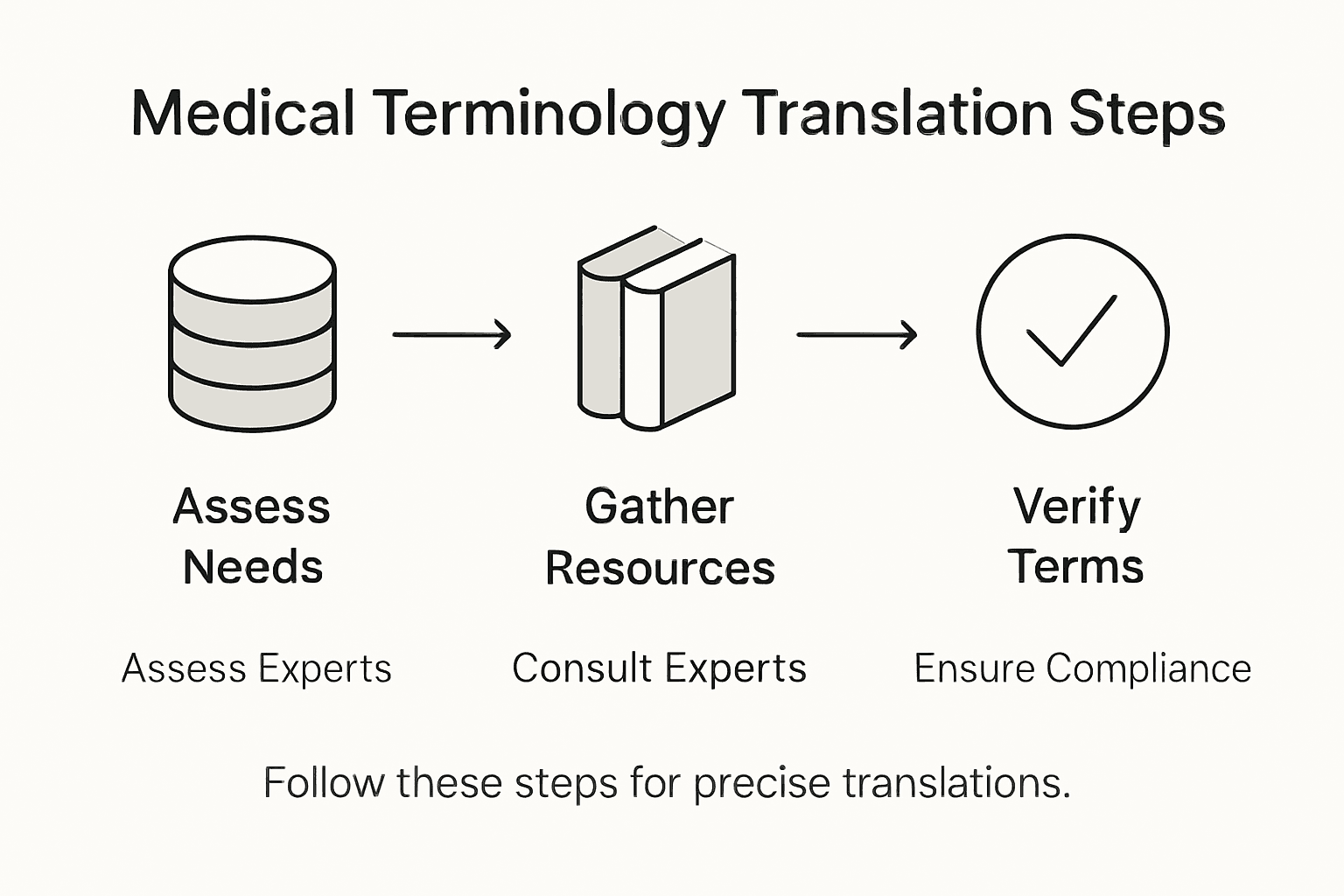
When gathering trusted resources, prioritise official medical terminology standards and comprehensive bilingual glossaries. Official healthcare terminology standards like SNOMED CT and ICD provide structured vocabularies essential for consistent medical documentation, enabling precise translations between English and Spanish. Your resource collection should include professional medical dictionaries, specialised bilingual terminology databases, academic medical journals, and authoritative healthcare publications from both English and Spanish speaking regions.
Ensure your resources cover multiple medical specialities and represent different regional variations of medical Spanish. This means collecting materials from Spain, Latin America, and the United Kingdom to capture nuanced linguistic differences. Academic medical libraries, professional translation associations, and healthcare institutions often provide comprehensive terminology guides that can significantly enhance your translation precision.
Professional advice: Create a digital reference library with cloud synchronisation to ensure your medical terminology resources are always accessible and up to date across multiple devices.
Here’s a summary of key considerations when assembling medical translation resources:
| Resource Type | English Example | Spanish Example | Main Use |
|---|---|---|---|
| Official Standards | SNOMED CT | CIE-10 (ICD-10) | Consistent medical coding |
| Professional Dictionaries | Oxford Medical Dictionary | Diccionario Médico Salvat | Accurate term definitions |
| Academic Journals | BMJ, The Lancet | Revista Española de Cardiología | Latest clinical terminology |
| Regional Guides | NHS Terminology Guide | Tesauros médicos latinoamericanos | Local linguistic variations |
Step 3: Apply glossary techniques for accuracy
Precise medical translation requires systematic approaches to terminology management that ensure linguistic consistency and professional accuracy. Professional terminology management guides provide critical techniques for building comprehensive translation glossaries that streamline your translation workflow and minimise potential misunderstandings.

When applying glossary techniques, focus on creating a structured terminology database that captures nuanced medical vocabulary across different specialities. Medical terminology resources recommend carefully defining terms, managing complex acronyms, and avoiding error prone abbreviations to maintain clarity in English and Spanish healthcare communications. Your glossary should include precise definitions, contextual usage notes, preferred translations, and potential regional variations that might impact medical understanding.
Establish a dynamic glossary management process that allows continuous refinement and collaboration. This involves regularly updating your terminology database, cross referencing multiple authoritative sources, and potentially developing speciality specific glossaries for fields like oncology, cardiology, or neurology. Engage with professional medical translation networks and linguistic experts to validate and enhance your terminology choices, ensuring that your glossary remains current and academically rigorous.
Professional advice: Implement a version controlled digital glossary system that tracks terminology changes and allows multiple translators to contribute and verify medical translations collaboratively.
The following table compares glossary management techniques for medical translation accuracy:
| Technique | Purpose | Benefit |
|---|---|---|
| Structured Database | Organise terms with context | Reduces ambiguity |
| Version Control | Track terminology changes | Ensures up-to-date usage |
| Peer Review | Validate terms with experts | Improves accuracy and reliability |
| Speciality Glossaries | Focus on fields like oncology | Enhances subject-specific precision |
Step 4: Verify terminology with healthcare stakeholders
Effective medical translation requires collaborative verification with professionals who understand the nuanced linguistic and clinical contexts of medical terminology. The National Council on Interpreting in Health Care emphasises the critical importance of engaging healthcare professionals to validate translation accuracy, ensuring translations are both clinically precise and culturally appropriate.
Consulting authoritative medical resources helps translators confirm terminology meanings and compliance with current clinical practice standards, creating a robust validation process. Your verification strategy should involve multiple healthcare stakeholders including clinicians, medical linguists, cultural mediators, and subject matter experts from both English and Spanish speaking regions. This collaborative approach allows you to cross reference terminology, understand contextual subtleties, and identify potential misinterpretations that could compromise patient communication and medical understanding.
Develop a systematic verification workflow that includes structured consultation processes, peer review mechanisms, and feedback loops with medical professionals. This might involve creating expert panels, conducting terminology review workshops, or establishing ongoing communication channels with healthcare institutions in different regions. Pay special attention to region specific medical terminology variations, ensuring your translations remain accurate across diverse Spanish speaking healthcare environments.
Professional advice: Schedule periodic terminology validation sessions with multilingual medical professionals to continuously refine and update your translation approaches.
Step 5: Review translations for confidentiality and compliance
Medical translation requires rigorous processes to protect patient privacy and maintain legal standards, ensuring every translated document meets strict confidentiality protocols. Translators must approach each medical document with an understanding of the sensitive nature of healthcare information and the potential consequences of inappropriate disclosure.
The ethical guidelines established by medical associations provide comprehensive frameworks for maintaining patient confidentiality during translation processes, emphasising the critical importance of secure document handling. Your review process should incorporate multiple layers of protection including anonymising patient identifiers, using secure encrypted transmission methods, implementing strict access controls, and developing comprehensive documentation tracking systems that prevent unintended information exposure.
Establish a systematic review workflow that includes detailed compliance checks against relevant healthcare regulations such as HIPAA and data protection standards. This involves creating comprehensive checklists that address linguistic accuracy while simultaneously protecting patient privacy. Consider developing specialised review protocols for different types of medical documents including patient records, research materials, clinical trial documentation, and institutional communications, each requiring nuanced confidentiality approaches.
Professional advice: Implement a digital verification system with multi factor authentication and automatic redaction tools to enhance translation confidentiality and compliance.
Enhance Your Medical Translations with Expert Precision and Confidentiality
Navigating the complex world of English Spanish medical terminology demands more than basic translation skills. This guide reveals how crucial it is to assess specialised vocabulary, manage comprehensive glossaries, and verify terminology with healthcare professionals to avoid costly errors. Understanding the challenges such as cultural nuances, abbreviation management, and strict confidentiality requirements is essential for translators working with high stakes healthcare documents.
At Pablo Hernando, we specialise in delivering precise and reliable medical translations tailored specifically for the UK and Spanish healthcare environments. With extensive experience across sensitive patient facing documents and regulated content, our service ensures:
- Rigorous terminology accuracy reflecting current clinical standards
- Strict confidentiality aligned with healthcare data protection regulations
- Seamless handling of complex medical specialities and regional language variations
Our professional approach is backed by academic expertise and direct collaboration with medical experts, guaranteeing translations that inspire confidence and meet urgent deadlines.
Ready to elevate your medical translations with trusted expertise? Visit our main site to discover tailored solutions that meet the unique demands of English UK to Spanish healthcare communication. Contact us today and secure precision and confidentiality for your next medical translation project.
Frequently Asked Questions
What steps should I take to assess my medical terminology needs for translation?
To assess your medical terminology needs, start by mapping out the specific healthcare domains you will translate. Examine medical specialities and compile a detailed inventory of terms used within each field, focusing on anatomical structures and patient communication phrases.
How can I gather reliable English and Spanish medical translation resources?
Gather high-quality bilingual terminology references by prioritising official medical terminology standards and comprehensive bilingual glossaries. Create a collection of professional dictionaries, academic journals, and authoritative publications to enhance your terminology knowledge.
What techniques can I apply to create an accurate medical glossary?
Apply glossary techniques by building a structured terminology database that defines terms, manages acronyms, and includes regional variations. Regularly update your glossary through peer reviews and cross-referencing multiple authoritative sources to maintain accuracy.
How do I verify the terminology I use with healthcare stakeholders?
Engage healthcare professionals to verify your translations by establishing a systematic consultation process. Collaborate with clinicians and subject matter experts to cross-reference terminology and identify potential misinterpretations that could affect communication.
What measures should I take to ensure confidentiality in medical translations?
Ensure confidentiality by implementing rigorous processes that protect patient privacy, such as anonymising identifiers and using secure document handling methods. Develop comprehensive checklists to address both linguistic accuracy and compliance with privacy standards during your reviews.